Artivorin Official Website › Joint Support Guide
Joint Support GuideThe Joint Support Supplement Guide: What Is In Them, And What Was Measured
Joint supplements are mostly built from six or seven ingredients, and the evidence behind them is uneven in ways the labels rarely explain. This guide sets out what the category actually contains, what the trials measured and at what doses, and the four things worth checking on any bottle before you spend anything at all.
Written for somebody who has never bought one of these, and written so that it stays useful if you end up buying a different bottle.
What a joint supplement is, and what it is not
A joint supplement is a dietary supplement sold to support comfort and movement. It is not a medicine, it is not reviewed for effectiveness before it goes on sale, and it does not treat a diagnosis. Those are not disclaimers so much as a description of the regulatory category, and the NIH Office of Dietary Supplements factsheet is the clearest short account of what that means in practice.
The practical consequence is that the burden of judgement falls on the buyer in a way it does not with a prescription. Nobody has checked, in advance, that the bottle in front of you contains what it says or does what the front label implies.
That is worth knowing without becoming paranoid about it. Most of this category is ordinary, the ingredients are widely used, and the useful question is not whether a product is a scam but whether you can check anything at all about it.
Osteoarthritis is a diagnosis with a management plan behind it. MedlinePlus explains what it is, and the 2019 rheumatology guideline puts exercise and weight management at the top of the list. A supplement sits alongside those. Anything sold as a replacement for them is being sold dishonestly.
The ingredients you will actually meet
| Ingredient | What it is | Where its evidence sits |
|---|---|---|
| Glucosamine and chondroitin | The category default, usually taken several times a day | Large trials with mixed and much-argued results, and the most studied pairing in the category by a distance |
| Turmeric extract or curcumin | A standardised botanical extract, usually 95 per cent curcuminoids | Thirty randomised trials in knee osteoarthritis, measuring pain and stiffness scores |
| Boswellia | A resin extract, often standardised to boswellic acids | Ranked first for pain and stiffness in a 2025 network meta-analysis of seven supplements |
| Collagen peptides | A protein powder or capsule, usually type II | A smaller but real trial record, mostly in activity-related joint discomfort |
| MSM | A sulphur compound, cheap and very widely used | A modest trial record, frequently combined with glucosamine |
| Coenzyme Q10 | A compound involved in cellular energy production | Well studied, and almost entirely outside joints |
| Alpha lipoic acid | An antioxidant with two very large trials behind it | Those trials are in diabetic nerve pain rather than in joints |
Two of the seven carry the joint evidence in this category. The rest appear for other reasons, some of them good.
The honest summary of that table is that this category has one strong botanical story, curcumin, one long-running argument, glucosamine and chondroitin, and a supporting cast of ingredients whose research records are real but were built somewhere else.
A label naming six ingredients is not therefore six times as good as one naming two. It is more likely to be six things at amounts nobody has tested, which is the pattern worth recognising.
What the trials actually measured, and at what dose
This is the part labels almost never carry and it is the part worth memorising, because it is the yardstick for everything else.
The 2014 curcuminoid trial used 1,500 mg a day of curcuminoids, split into three doses, over six weeks. A 367-patient study ran the same amount against ibuprofen at 1,200 mg a day for four weeks and reported comparable symptom scores. The 2024 review of eleven meta-analyses pools the field.
What those trials measured was symptom scoring: how much a knee hurt, how stiff it was, how well it functioned. They did not photograph cartilage. A product claiming to rebuild a joint is claiming something the research behind its own ingredients did not look for.
It is also worth reading the 2025 critical appraisal of those reviews, which examines how well the underlying trials were run rather than simply pooling them, and the 2025 network meta-analysis of thirty-nine trials which compares seven supplements against each other.
| Ingredient | Dose the published trials used | What they measured |
|---|---|---|
| Curcuminoids | 1,500 mg a day in three divided doses | Pain, stiffness and function scores over four to six weeks |
| Coenzyme Q10 | 300 to 400 mg a day | Circulating inflammatory markers, not joints |
| Alpha lipoic acid | 600 mg a day | Nerve pain symptoms in diabetic polyneuropathy |
| Butcher’s broom | 150 mg of root extract per capsule | Leg volume in chronic venous insufficiency |
The right-hand column is the one to read. Three of these four rows measured something other than a joint.
Absorption, and the one technical point worth carrying
Curcumin has a well-documented problem: taken by itself it barely reaches the bloodstream. The classic pharmacokinetic study gave volunteers two grams of plain curcumin and found serum levels undetectable or very low, then added 20 mg of piperine and watched them rise sharply.
That is why so many curcumin products name black pepper extract, a phospholipid complex or a micellar formulation on the front of the bottle. It is a genuine competitive feature and manufacturers who have one say so loudly.
So the absence of any such name on a label is information. It does not prove there is no enhancer inside, but it is the first question worth asking a seller, and a seller who cannot answer it has told you something as well. NCCIH’s turmeric page is the plain government summary of the ingredient generally.
The ingredients that are studied somewhere else
A pattern worth recognising, because it appears on a great many labels in this category and it is almost never explained.
Butcher’s broom has a 166-patient placebo-controlled trial and a meta-analysis of the standard combination behind it. Every one of those trials is in chronic venous insufficiency and the endpoint is leg volume. It is a vein ingredient.
Alpha lipoic acid has SYDNEY 2 and the four-year NATHAN 1 trial, both at 600 mg a day in diabetic polyneuropathy. It is a nerve ingredient.
Coenzyme Q10 has a dose-response analysis of inflammatory markers and a substantial literature in statin muscle symptoms. It is neither a vein nor a joint ingredient.
None of that makes any of them a bad thing to include. It means the correct description of a label carrying them is one lead ingredient and several supporting ones, rather than four joint ingredients, and a seller who describes it the second way is either not reading the research or hoping you will not.
Four things to check on any bottle in this category
Are the amounts printed?
A panel with milligram figures lets you compare the product with the trials. A label that names ingredients without amounts does not, and neither does a proprietary blend that pools them into one total.
Which ingredient is the lead one?
Find the one with the joint evidence and ask what amount it is at. Everything else on the label is supporting cast, whatever the order on the front of the bottle suggests.
Is there anything to help absorption?
For a curcumin product this is the second most useful question after the amount, and it is answered in one word on any label that has one.
How long is the window, and when does it start?
This category works over four to six weeks or not at all, so a thirty-day window closes at roughly the point most people first notice anything. Check whether the clock starts at purchase or at despatch.
NCCIH’s page on using supplements sensibly is worth ten minutes before any purchase in this category, and it is written by somebody with nothing to sell you.
Who publishes this Artivorin website?
Sixteen sources, which is most of what this desk has read on the category. Each is linked in the sentence that uses it.
- Panahi Y, Rahimnia AR, Sharafi M, et al. Curcuminoid treatment for knee osteoarthritis: a randomized double-blind placebo-controlled trial. Phytother Res. 2014;28(11):1625-31. PMID 24853120. Dose: 1,500 mg/day of curcuminoids in three divided doses for 6 weeks. https://pubmed.ncbi.nlm.nih.gov/24853120/
- Kuptniratsaikul V, Dajpratham P, Taechaarpornkul W, et al. Efficacy and safety of Curcuma domestica extracts compared with ibuprofen in patients with knee osteoarthritis: a multicenter study. Clin Interv Aging. 2014;9:451-8. PMID 24672232. Dose: 1,500 mg/day of Curcuma domestica extract against ibuprofen 1,200 mg/day for 4 weeks. https://pubmed.ncbi.nlm.nih.gov/24672232/
- Bideshki MV, Jourabchi-Ghadim N, Radkhah N, et al. The efficacy of curcumin in relieving osteoarthritis: a meta-analysis of meta-analyses. Phytother Res. 2024;38(6):2875-2891. PMID 38576215. https://pubmed.ncbi.nlm.nih.gov/38576215/
- Zhang Y, Gui Y, Adams R, et al. Comparative effectiveness of nutritional supplements in the treatment of knee osteoarthritis: a network meta-analysis. Nutrients. 2025;17(15):2547. PMID 40806131. Thirty-nine randomised trials, 4,599 patients; Boswellia ranked first for pain and stiffness, curcumin among those showing benefit on some outcomes. https://pubmed.ncbi.nlm.nih.gov/40806131/
- Chen J, Zhou Q, Yu W, et al. A critical review of systematic reviews and meta-analyses of curcumin for knee osteoarthritis. Front Pharmacol. 2025;16:1664319. PMID 41560742. https://pubmed.ncbi.nlm.nih.gov/41560742/
- Shoba G, Joy D, Joseph T, et al. Influence of piperine on the pharmacokinetics of curcumin in animals and human volunteers. Planta Med. 1998;64(4):353-6. PMID 9619120. After 2 g of curcumin alone, human serum levels were undetectable or very low; 20 mg of piperine alongside it raised them sharply. https://pubmed.ncbi.nlm.nih.gov/9619120/
- Hou S, Tian Z, Zhao D, et al. Efficacy and optimal dose of coenzyme Q10 supplementation on inflammation-related biomarkers: a GRADE-assessed systematic review and updated meta-analysis of randomized controlled trials. Mol Nutr Food Res. 2023;67(13):e2200800. PMID 37118903. Dose: 300-400 mg/day showed the strongest effect on inflammatory mediators. https://pubmed.ncbi.nlm.nih.gov/37118903/
- Vanscheidt W, Jost V, Wolna P, et al. Efficacy and safety of a Butcher's broom preparation (Ruscus aculeatus L. extract) compared to placebo in patients suffering from chronic venous insufficiency. Arzneimittelforschung. 2002;52(4):243-50. PMID 12040966. Twelve weeks; the endpoint was leg volume, not joint pain. https://pubmed.ncbi.nlm.nih.gov/12040966/
- Boyle P, Diehm C, Robertson C. Meta-analysis of clinical trials of Cyclo 3 Fort in the treatment of chronic venous insufficiency. Int Angiol. 2003;22(3):250-62. PMID 14612852. Dose: capsules of 150 mg Ruscus aculeatus root extract with 150 mg hesperidin methyl chalcone and 100 mg ascorbic acid. https://pubmed.ncbi.nlm.nih.gov/14612852/
- Ziegler D, Ametov A, Barinov A, et al. Oral treatment with alpha-lipoic acid improves symptomatic diabetic polyneuropathy: the SYDNEY 2 trial. Diabetes Care. 2006;29(11):2365-70. PMID 17065669. Doses: 600, 1,200 and 1,800 mg once daily for 5 weeks; the authors concluded 600 mg gave the best risk-to-benefit ratio. https://pubmed.ncbi.nlm.nih.gov/17065669/
- Ziegler D, Low PA, Litchy WJ, et al. Efficacy and safety of antioxidant treatment with alpha-lipoic acid over 4 years in diabetic polyneuropathy: the NATHAN 1 trial. Diabetes Care. 2011;34(9):2054-60. PMID 21775755. Dose: 600 mg once daily for four years in 460 patients. https://pubmed.ncbi.nlm.nih.gov/21775755/
- Kolasinski SL, Neogi T, Hochberg MC, et al. 2019 American College of Rheumatology/Arthritis Foundation guideline for the management of osteoarthritis of the hand, hip, and knee. Arthritis Rheumatol. 2020;72(2):220-233. PMID 31908163. https://pubmed.ncbi.nlm.nih.gov/31908163/
- Osteoarthritis. MedlinePlus, U.S. National Library of Medicine. https://medlineplus.gov/osteoarthritis.html
- Turmeric. National Center for Complementary and Integrative Health, National Institutes of Health. https://www.nccih.nih.gov/health/turmeric
- Using Dietary Supplements Wisely. National Center for Complementary and Integrative Health, National Institutes of Health. https://www.nccih.nih.gov/health/using-dietary-supplements-wisely
- Dietary Supplements: What You Need to Know. Office of Dietary Supplements, National Institutes of Health. https://ods.od.nih.gov/factsheets/WYNTK-Consumer/
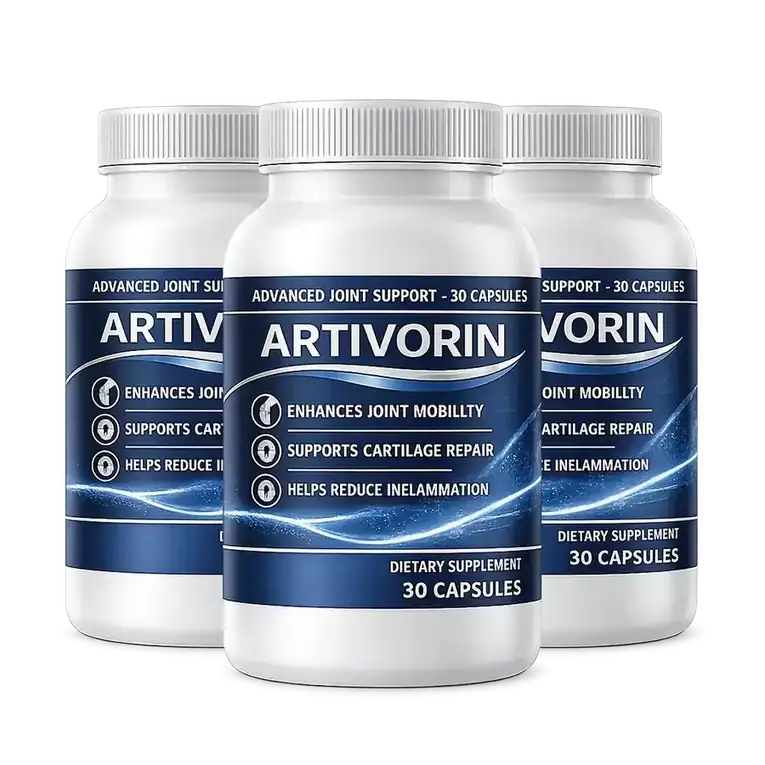
How Artivorin scores against the four checks above
Two of the four are answered well and two are not, which is set out in full on the checklist guide rather than glossed here.
Two bottles $178 · three bottles $216 · six bottles $294 · 60 days from the date of purchase
Order Artivorin On The Official WebsiteLot ART-26/GO-8345 · one a day · 30 in every bottle