Artivorin Official Website › Blog › Statins, Muscle Ache And CoQ10
Statins, Muscle Ache And The CoQ10 On This Label
Coenzyme Q10 turns up on joint labels across this category, and almost everything published about it is about something else. Its largest literature is in muscle symptoms among people taking a statin, and even that literature cannot agree with itself. Here is what it actually says, and what it means for a bottle you are looking at.
- Coenzyme Q10 has zero randomised controlled trials in osteoarthritis.
- Its biggest literature is muscle symptoms in people taking a statin, and two meta-analyses of that literature reach opposite conclusions.
- The dose-response work on inflammatory markers points at 300 to 400 mg a day.
- Its nearest approach to a pain indication is a single trial in fibromyalgia.
- On a joint label it is a supporting ingredient. Anybody presenting it as joint evidence is describing a literature that does not exist.
Why coenzyme Q10 appears on a joint label at all
Coenzyme Q10 is a compound your cells use in the process that produces energy, and it is concentrated in tissues that work hard. That single sentence is the whole of the reason it appears on labels in a dozen unrelated categories, because a compound involved in energy production can be made to sound relevant to almost anything.
It is also genuinely well studied, which is not true of every botanical on a supplement shelf. There are hundreds of trials, a substantial safety record and a mainstream government page explaining it: NCCIH publishes one and it is worth five minutes.
What there is not is a joint literature. Searched against osteoarthritis, coenzyme Q10 returns sixteen papers that mention the condition and no randomised controlled trials at all. That is not an argument about quality or about interpretation; it is a count, and it was taken on 18 September 2026.
So a label can name it truthfully, and a seller can describe it as clinically studied truthfully, while the studies in question measured something a buyer with a stiff knee is not asking about. That gap is the subject of this piece.
The statin story, and why it is unresolved
Some people taking a statin report muscle aches, weakness or cramp. The proposed explanation involves coenzyme Q10, because statins reduce the body's own production of it alongside the cholesterol they are prescribed to lower. That is a plausible mechanism, it has been taken seriously for two decades, and it has been tested repeatedly.
A 2018 meta-analysis of randomised controlled trials pooled the evidence and reported a benefit on muscle pain, weakness, cramp and tiredness. That result is the one quoted on a great many supplement pages, and it is a real published finding.
A 2020 systematic review and meta-analysis looked at the same question with a later set of trials and found no effect on statin-associated myalgia and none on whether people stayed on their statin. That is also a real published finding, and it is quoted almost nowhere.
| The analysis | What it pooled | What it concluded |
|---|---|---|
| Qu 2018, meta-analysis of randomised trials | Trials of coenzyme Q10 in people reporting muscle symptoms on a statin | A benefit on muscle pain, weakness, cramp and tiredness |
| Kennedy 2020, systematic review and meta-analysis | A later set of trials on statin-associated myalgia and on whether people stayed on their statin | No effect on the muscle symptoms and none on adherence |
| Hou 2023, dose-response meta-analysis | Trials measuring circulating inflammatory markers rather than symptoms | 300 to 400 mg a day produced the strongest effect on those markers |
Two of these three are about muscles and they disagree. The third is about blood markers and is the one most often quoted as though it were about joints.
Two careful analyses of the same question reaching opposite conclusions is not a scandal. It is what a genuinely unresolved question looks like, and it usually means the effect, if there is one, is small enough that which trials you include changes the answer.
The honest position is that coenzyme Q10 for statin muscle symptoms is unsettled. A page citing only the 2018 analysis is not lying, but it has chosen one of two answers and not mentioned that the other exists.
Why this matters on a joint label specifically
Because muscle ache and joint ache are not the same thing, and the person buying a joint supplement is usually not on a statin at all.
If you are, the statin literature is about you and it is inconclusive. If you are not, it is about a different population entirely, and the presence of coenzyme Q10 on the label tells you nothing about how your knee will feel in six weeks.
Inflammatory markers, and the number everyone quotes
The other literature on coenzyme Q10 is about markers in the blood rather than symptoms in a person. A dose-response meta-analysis published in 2023 pooled randomised trials measuring inflammatory mediators and found the strongest effect at 300 to 400 mg a day.
That figure is the one worth writing down, and it is worth writing down for an uncomfortable reason. Three hundred to four hundred milligrams a day of a single ingredient is a substantial amount, and a once-daily capsule carrying four ingredients cannot physically hold that much alongside everything else on the label.
A marker moving in a blood sample is also a long way from a knee feeling different on a Tuesday. Marker studies are how a mechanism gets investigated; they are not how a benefit gets established, and a page that presents one as the other has skipped the hard part.
“Clinically studied to support a healthy inflammatory response.” That phrasing is usually built on marker work rather than symptom work, and the two are not interchangeable. Ask what the trial measured, not whether there was one.
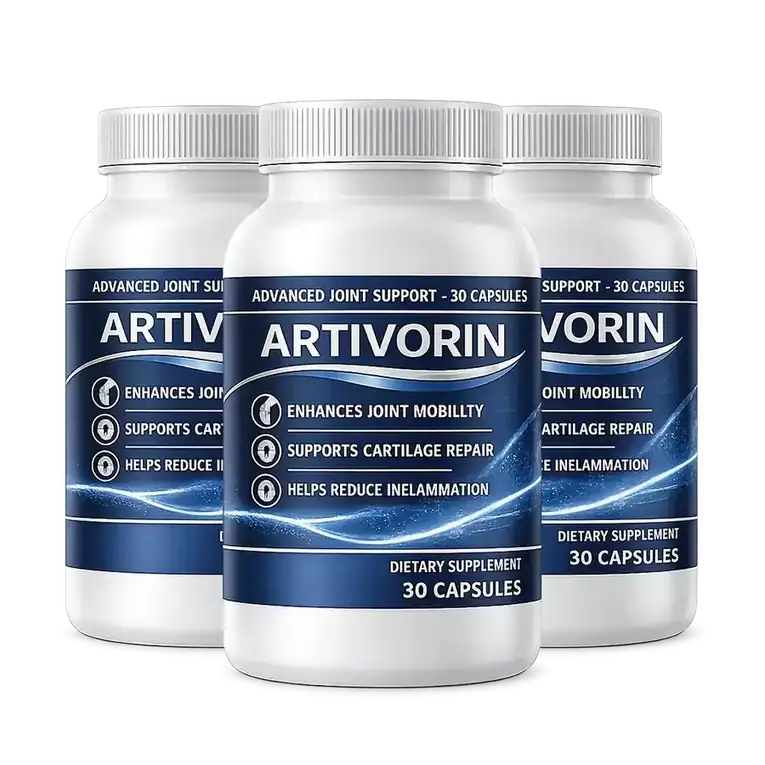
Artivorin names four ingredients and leads on one of them
Turmeric extract at 95 per cent curcuminoids is the ingredient with a joint literature behind it. Coenzyme Q10, butcher’s broom and alpha lipoic acid are supporting ingredients, and the Artivorin ingredients page says what each one was actually tested on.
Two bottles $178 · three bottles $216 · six bottles $294 · 60 days from the date of purchase
Order Artivorin On The Official WebsiteLot ART-26/GO-8345 · one a day · 30 in every bottle
The one pain trial, and what it was about
There is a single trial that brings coenzyme Q10 anywhere near a pain indication, and it is worth naming precisely. a 2019 study in fibromyalgia patients already taking pregabalin reported an effect on pain alongside changes in brain activity and mitochondrial measures.
Fibromyalgia is not osteoarthritis. It is a different condition with a different proposed mechanism, a different patient group and a different treatment pathway, and a result there does not transfer to a knee any more than a result in a knee would transfer to it.
That trial is cited here because leaving it out would be the mirror image of the problem this post is about. It exists, it is the closest thing to a pain result this ingredient has, and it is still not about the thing on the front of the bottle.
The dose problem this creates on an unlabelled bottle
Every number in this post is a trial dose. None of them is a label dose, because the product this desk sells does not publish one and a great many products in this category do not either.
That turns the comparison into an exercise in arithmetic about what a capsule can hold. A standard capsule of the usual size carries a few hundred milligrams of powder in total. Four ingredients at the doses their own trials used would be several grams a day, and nobody sells several grams a day in one capsule.
So a four-ingredient once-daily capsule in this category is necessarily working below the trial doses, whoever makes it. That is a statement about the format rather than an accusation about any particular seller, and it is the single most useful thing to hold in mind while reading any label in this aisle.
- A trial dose is a published number you can check.
- A label dose is a number the seller chooses to print, or not.
- A capsule size is a physical limit that applies to everybody equally.
- Where the label dose is missing, only the first and third are available to you.
- Two of three is still more than most buyers ever work out.
What it means for you, row by row
The practical question is not whether coenzyme Q10 is a good ingredient. It is whether its presence on a label should change anything you do, and for most readers the answer is no.
| If this is you | What the CoQ10 on a joint label means for you | What to do |
|---|---|---|
| On a statin, no muscle symptoms | Nothing in particular. The trials are in people who have symptoms | Nothing. Mention it at your next review like anything else you take |
| On a statin, with muscle aches | You are the population two analyses disagree about, at doses nobody here can confirm | Raise the aches themselves first. They have causes other than the statin |
| On warfarin | Coenzyme Q10 has been tested in stable long-term warfarin patients | Say so before you start. It is a one-sentence conversation |
| Already taking a separate CoQ10 capsule | Two products with an overlapping ingredient, one of which prints no amount | Pick one. Two unknowns are worse than one |
| None of the above | A supporting ingredient on a turmeric-led label | Judge the product on its lead ingredient instead |
The second row is the only one where the research is genuinely about you, and it is the row where the research disagrees with itself.
The fourth row is the one people miss. Somebody already taking a dedicated coenzyme Q10 capsule, at a printed amount, who then adds a joint formula containing an unprinted amount of the same thing, has made their own situation harder to reason about for no benefit.
The third row is the one worth acting on. a randomised crossover trial tested coenzyme Q10 in stable long-term warfarin outpatients, and anybody whose warfarin dose has been carefully titrated should mention a new supplement rather than assume it is inert.
Muscle aches have several causes and a statin is only one of them. Raising the aches themselves with whoever prescribes the statin is more useful than adding a supplement to them, and it is also the conversation in which a supplement can be mentioned.
The fair verdict on a supporting ingredient
None of this is an argument that coenzyme Q10 should not be on a joint label. Formulators combine a lead ingredient with supporting ones for reasons that are often sensible, and an ingredient with a large safety record and a plausible mechanism is a reasonable thing to include.
The argument is about description. A label naming four ingredients invites a reader to assume four joint ingredients, and on this label and most others in the category that assumption is wrong. One carries the joint evidence and three were studied elsewhere.
A seller who says so is easier to trust on everything else, which is the whole reason this desk writes it down. The evidence for the lead ingredient is not weakened by admitting that the supporting cast is a supporting cast.
If you are choosing between products in this aisle, the useful move is to ignore the ingredient count entirely and find the lead ingredient and its amount. The eight-point checklist sets out how, and the category guide lists what each common ingredient was actually tested on.
References
- Qu H, Guo M, Chai H, et al. Effects of coenzyme Q10 on statin-induced myopathy: an updated meta-analysis of randomized controlled trials. J Am Heart Assoc. 2018;7(19):e009835. PMID 30371340. https://pubmed.ncbi.nlm.nih.gov/30371340/
- Kennedy C, Koller Y, Surkova E. Effect of coenzyme Q10 on statin-associated myalgia and adherence to statin therapy: a systematic review and meta-analysis. Atherosclerosis. 2020;299:1-8. PMID 32179207. https://pubmed.ncbi.nlm.nih.gov/32179207/
- Hou S, Tian Z, Zhao D, et al. Efficacy and optimal dose of coenzyme Q10 supplementation on inflammation-related biomarkers: a GRADE-assessed systematic review and updated meta-analysis of randomized controlled trials. Mol Nutr Food Res. 2023;67(13):e2200800. PMID 37118903. Dose: 300-400 mg/day showed the strongest effect on inflammatory mediators. https://pubmed.ncbi.nlm.nih.gov/37118903/
- Engelsen J, Nielsen JD, Winther K. Effect of coenzyme Q10 and Ginkgo biloba on warfarin dosage in stable, long-term warfarin treated outpatients. A randomised, double blind, placebo-crossover trial. Thromb Haemost. 2002;87(6):1075-6. PMID 12083489. https://pubmed.ncbi.nlm.nih.gov/12083489/
- Sawaddiruk P, Apaijai N, Paiboonworachat S, et al. Coenzyme Q10 supplementation alleviates pain in pregabalin-treated fibromyalgia patients via reducing brain activity and mitochondrial dysfunction. Free Radic Res. 2019;53(8):901-909. PMID 31387429. https://pubmed.ncbi.nlm.nih.gov/31387429/
- Coenzyme Q10. National Center for Complementary and Integrative Health, National Institutes of Health. https://www.nccih.nih.gov/health/coenzyme-q10